Why Genre Labels Keep Moving
Why genre labels keep moving: understand how music categories shift and use them to find sounds without mistaking a useful shortcut for a fixed boundary.
The most common mistake with genre labels is treating them as permanent boxes: a listener searches for one sound, gets a narrow set of results and misses music that grew beside it. Why genre labels keep moving is easier to understand if a label is treated like a paper tag on a record sleeve: useful for finding a starting point, but easy to replace as the music and its audience change.
Broad labels
A broad label can point to a family of sounds while concealing how different its members are. “Electronic”, for instance, might describe music built around synthesizers, sampled drums, club structures or slowly changing textures. The word helps a shop, radio programme or streaming service group material, but may not tell you what a particular track feels like.
Genre names often begin as convenient descriptions rather than complete musical definitions. A label can gather artists with shared instruments or production habits, then stretch to include adjacent sounds as listeners make connections between them. It remains useful for browsing even as its edges become less precise.
Add a second clue rather than rejecting the broad term. Search for an instrument, mood, place or production quality alongside it: “electronic with dub bass” asks for something more specific than “electronic” alone. If the results still feel scattered, use a track or artist you already like as your next reference point.
Narrow labels
A narrow name can make a scene legible to people inside it and confusing to everyone else. It may distinguish a local sound, a production approach or a small group of artists from a larger category. Outside that context, the term may look like needless subdivision, particularly if a shop or platform files everything under a broader heading.
Disagreement often comes down to what a label is meant to do. A musician might use it to describe a community and its shared practices; a critic might use it to compare sound; a retailer might use it to help a customer find a shelf. Those purposes overlap, but they are not identical, so one word can feel precise in conversation and vague in a catalogue.
If a label is unfamiliar, look at the artists and sounds people associate with it before deciding that it is empty jargon or a settled category. Notice whether the name points to a rhythm, instrument, production method, place or social scene. That clue is often more useful than expecting a short label to carry a full history.
Listening perspectives?
Why do two people name the same track differently?
They may be listening for different features: one hears the drum pattern, another the vocal style or the track’s connection to a scene. They may also have learnt the term through different communities, where its boundaries were drawn for different reasons.
Does a genre name describe sound or audience?
It can do both, but not always to the same degree. Some labels chiefly describe audible traits, while others also carry associations with a place, a social group or the settings where people gather to hear the music.
Why do artists resist a genre label?
A label can help listeners find an artist, yet it can also make varied work seem narrower than it is. Artists may object when a category is imposed from outside, especially if it flattens a scene’s differences or carries baggage they do not claim.
Can a genre name become outdated?
Yes. A term can lose its local meaning, gather new associations or remain in use mainly as a catalogue heading. The music need not change for the word’s usefulness to change; its audience and context can shift too.
Crossing borders
Genre boundaries often move when musical practices and audiences meet. A producer might combine a rhythm associated with one dance scene and vocal phrasing heard elsewhere; listeners may recognise a connection that older labels do not capture. A name for the blend can help, but it can also obscure the distinct traditions that shaped it.
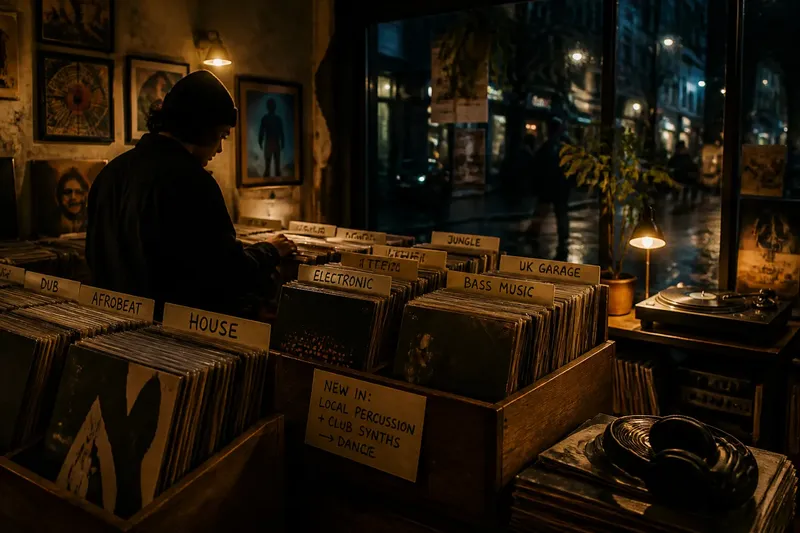
Say you run a small record shop and receive an invented new release combining a local percussion style with club-oriented synths. You check the sound, identify both features, then file it under the nearest broad dance category and add a listing note naming the percussion tradition and synth approach. Customers searching by dance music can still find it, while those following the percussion style have another route; the trade-off is that one catalogue category cannot represent every connection.
A sound can travel more easily than the context around it. A rhythm or vocal technique may be borrowed, adapted or transformed as it reaches new audiences. A genre name may reveal a connection, but cannot by itself explain who developed a practice, how it was used or what it means to the people who made it.
Catalogue differences
Music shops, radio stations, magazines and streaming services do not always sort recordings the same way. A shop might favour the section where a customer is most likely to find an album; a radio presenter may use a term that describes its sound; a platform may rely on categories broad enough to cover a large catalogue. Their labels answer different practical needs, so conflicting classifications are not automatically evidence that one is mistaken.
Ask what each label helps you do. A broad category may be good for browsing, while a narrower term may help you follow a scene or find related artists. If a search returns little, try the adjacent term used by another source, then compare descriptions and recordings rather than assuming a catalogue has drawn a definitive boundary.
A category can be effective for finding music and still be contested by the people it names. When an artist, critic or local scene uses a term differently from a platform, keep track of that context instead of forcing every source into one universal definition.
Contested terms
Genre names can carry assumptions about who makes music, who listens to it and which traditions count as central. A term may have been coined outside the scene it describes, or become a marketing category that simplifies a varied community. That history can affect whether people embrace the name, qualify it or avoid it.
When a label feels uncomfortable or disputed, pay attention to who is using it and for what purpose. An artist’s own description, a community’s language and a retailer’s search tag may not have equal meaning. You do not need to settle the term’s entire history before listening, but you can avoid presenting a contested label as neutral fact.
If the term’s origin or acceptability depends on a particular community, source or local context, follow the people most directly connected to it and use their wording with care. If no single usage is shared, describe the audible qualities plainly rather than treating the disputed name as the only option.
Genre labels in practice
Genre labels are most helpful when treated as invitations to explore, not verdicts on what a recording is. Start with the term that brought you to the music, then notice which feature holds your attention: a bass sound, vocal delivery, rhythm, instrument or production choice. That observation gives you a more personal search clue than the category alone.
When a genre label seems to fail, identify the problem before changing it: is it too broad, too narrow, tied to a different scene or carrying a meaning you do not intend? Try an adjacent term or a concrete sound description, and compare what each route brings up. Why genre labels keep moving becomes clearer when the word is treated as a working map: its borders shift because musicians, listeners and sellers keep drawing it for different journeys.